Incorporating a Malaysian company before launching operations can give foreign investors time to arrange licences, secure premises and prepare for market entry. However, the company’s compliance responsibilities begin before its first sale.
A company with no revenue may still need to submit annual filings, prepare financial statements and file tax returns. Dormant-company exemptions offer limited relief, but eligibility depends on the company’s actual activities and transactions.
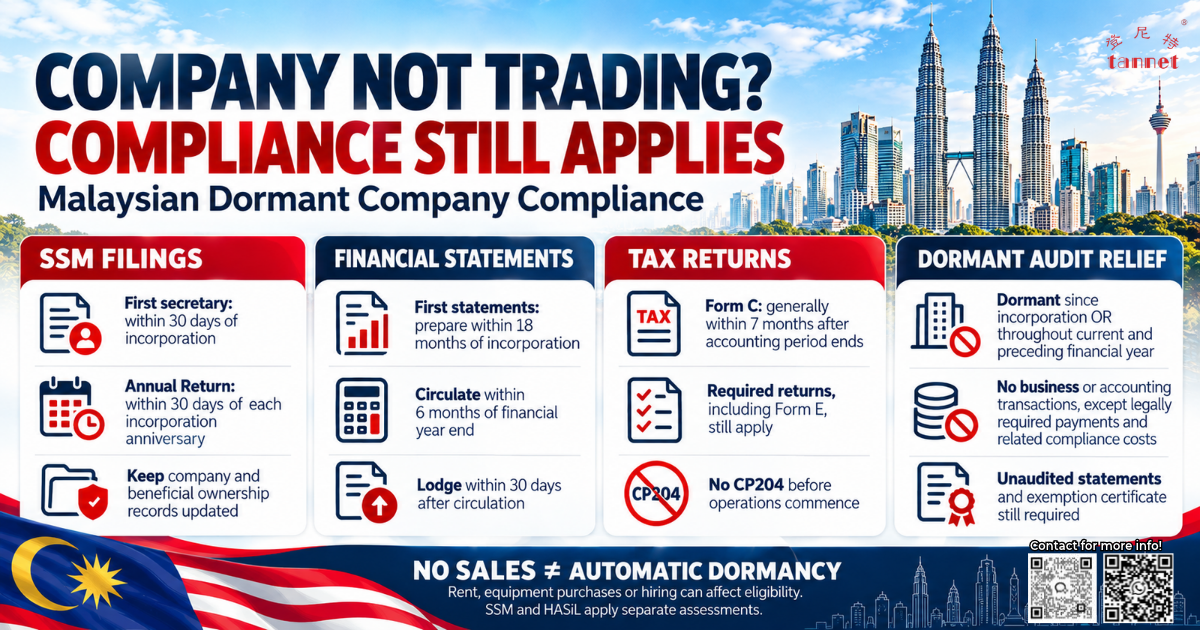
Malaysian dormant company compliance begins before your first sale. Even if your company has not started trading, it may still need to submit SSM filings, prepare financial statements and file tax returns. For foreign investors incorporating ahead of launch, understanding these obligations helps avoid missed deadlines and incorrect assumptions about dormant-company exemptions.
Company Secretarial Obligations Continue
A Malaysian private company must appoint its first company secretary within 30 days of incorporation, maintain a registered office in Malaysia and have at least one director who ordinarily resides in Malaysia.
These requirements continue even when the company has not started trading.
The company must also maintain its statutory registers, keep beneficial ownership information accurate and meet the relevant reporting requirements. Changes involving directors, shareholders, the registered office or other company particulars may trigger separate filing obligations.
Its Annual Return must generally be lodged with the Companies Commission of Malaysia, commonly known as SSM, within 30 days of each incorporation anniversary. This deadline follows the incorporation date, rather than the date trading begins.
Accounting Records and Financial Statements Are Still Required
No sales does not necessarily mean no accounting transactions.
A company may already have incorporation costs, statutory fees, shareholder funding, rental deposits or equipment purchases. These transactions must be properly recorded, with supporting documents retained.
Directors remain responsible for ensuring that the company maintains proper accounting records and prepares financial statements.
The first financial statements must be prepared within 18 months of incorporation. For a private company, financial statements must generally be circulated to members within six months of the financial year end and lodged with SSM within 30 days after circulation.
The Annual Return and financial statements are separate submissions with different deadlines.
When Does Dormant Audit Exemption Apply?
Under SSM’s Practice Directive 10/2024, a company may qualify for audit exemption through dormancy if it has been dormant since incorporation, or throughout both the current and immediately preceding financial year.
For this purpose, dormancy requires no business activity and no accounting transactions, except transactions arising from legally required payments and related compliance costs.
The directive excludes certain entities, including public companies, subsidiaries of public companies and registered foreign companies. A Malaysian-incorporated Sdn. Bhd. is not a registered foreign company simply because overseas investors own its shares.
Eligible companies must still lodge unaudited financial statements, supporting reports and the required exemption certificate. A qualifying shareholder request or Registrar’s direction can also require an audit.
Audit exemption removes the audit requirement; accounting and financial reporting responsibilities continue.
Tax Returns May Still Be Required
Dormant companies and companies that have not commenced business must still submit the tax returns required by the Inland Revenue Board of Malaysia, known as HASiL, including Form E.
The company income tax return, Form C, is generally due within seven months after the accounting period closes. Having no taxable income does not automatically remove the filing obligation.
Companies that have not commenced operations need not submit CP204 tax estimates. Once operations begin, the applicable tax estimation and instalment requirements should be reviewed.
HASiL also states that companies holding shares, real property, fixed deposits or similar investments are not considered dormant for its dormant-company guidance. SSM audit exemption and tax treatment therefore require separate assessments.
Practical Example: A Foreign Investor Preparing to Launch
A Japanese investor incorporates Sakura Market Sdn. Bhd. in March, planning to launch its Malaysian operations the following January.
The investor assumes that compliance work can wait because the company has no customers and has issued no invoices.
However, Sakura Market already needs a company secretary, a registered office, the required resident director and proper accounting records. Its annual filing deadlines also run independently of the launch date.
If the company’s transactions are confined to legally required payments and related compliance costs, it may qualify for dormant audit relief, subject to the remaining conditions.
If it begins paying rent, purchasing equipment or hiring employees, the absence of sales alone cannot establish dormancy. Placing funds in a fixed deposit also affects HASiL’s dormant classification.
Before these transactions take place, the investor should ask the company secretary and tax adviser to assess their effect on audit exemption, tax status and filing requirements.
Malaysian Dormant Company Compliance: Your Pre-Launch Checklist
Foreign investors should plan for company secretarial services, accounting, tax filings and any required audit from incorporation.
A useful starting point is to:
- Set the company’s financial year end and prepare a filing calendar.
- Record expenses and funding from the outset.
- Assess dormant status using actual transactions.
- Confirm audit exemption eligibility for each relevant financial year.
- Review tax obligations when operations, investments or staffing arrangements change.
Incorporating early can support a smoother launch. Keeping the company compliant during the waiting period helps ensure it is ready when business begins.
📞 Free 1-on-1 Consultation Now,
Official Service Hotline: +86-755-82148419
Cell: +86-13823131503;+60 19-309 2363
WeChat ID: 13823131503;
WhatsApp:+86-13823131503;+60 19-309 2363
Email: mytannet08@gmail.com; susiehu@citilinkia.com